
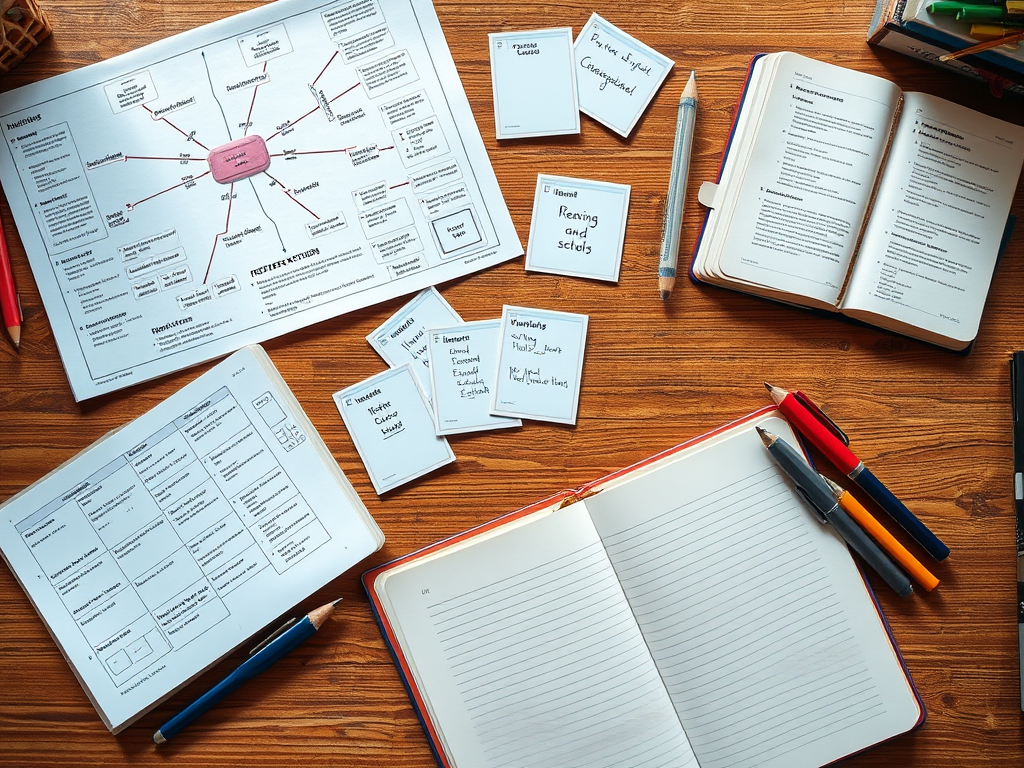
By starting here, you have chosen to plan your revision. This is absolutely the best start to your revision. The first section “Why do I need to read this?” talks about why this section and it’s strategies are important.
The second section “The Pomodoro* technique” describes one of the strategies in full.
The final section “Bringing it all together” describes how to combine a revision timetable with the Pomodoro technique.
1
Why do I need to read this?
Show me
Whilst it’s important to know what techniques to use during revision, it’s equally, if not more important, to plan your revision for any upcoming exams.
This section will detail an approach that you can use or tailor to your liking, to plan your revision.
The approach will consist of the following two elements:
- A time management technique
- A revision timetable technique
Planning your revision not only relieves some of stress around revision and exams – as you know what you’re doing next – but it also improves motivation (more on that later) as you can track whether you complete your planned revision or not.
Success happens when you start to hold yourself accountable for making it happen. So let’s start now.
On this site, we’ll always aim to tell you why a technique has been recommended. So, why do you need a time management technique, and why do we recommend a revision timetable?
Timetables
Easy, timetables in general help us stay more organised, you’ll know this from school just from your own lesson timetable. You can look at a day, and know exactly what lessons you’re expected to attend. Same with the working world, our timetables (aka our calendars) help us organise our meetings, or work time into (hopefully) effective chunks of time.
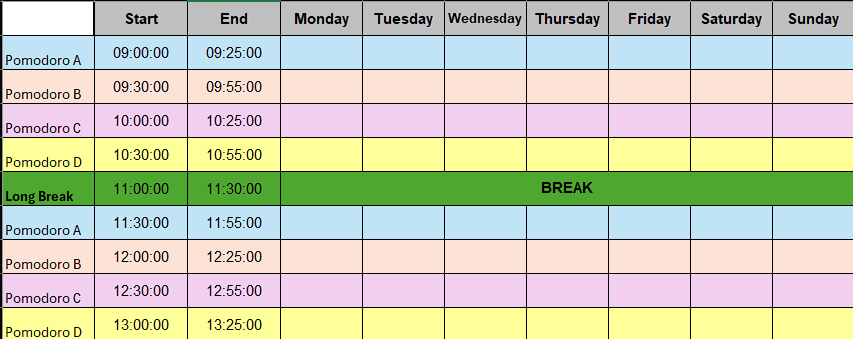
Additionally, using a timetable lines up with a well known technique we’ll simply call the “Calendar Approach”. Using this technique, you will highlight, tick, cross or somehow mark every revision session you complete. This has a huge impact on motivation as you start to see the ticks/crosses build up. And when you’re feeling not as motivated (which will happen) you can look at your timetable and think “Do I really want a gap here?”
Time management
It’s great to have a revision timetable as it helps you plan your overall revision days. However, if you don’t plan your revision time effectively on those days then your revision will be less effective, and feel like harder work.
Effective revisions is a combination of self-discipline + time management + revision techniques. The first one is all you, the other two you’ll learn about below.
TLDR: Planning revision is important, we’re going to use a timetable to track it. It’ll help plan, and motivate you to revise.
2
The Pomodoro* technique
Show me
This is an incredibly effective time management method, especially if you struggle with staying focused during revision. But it’s helpful for everyone!
We all have a limited capacity to focus (maxing out at 52 mins on average), the high-level idea for this technique is that you break your revision down into small, manageable chunks of time, with breaks in between.
This helps:
- Reduce mental fatigue (literally tiring your brain’s ability to concentrate)
- Increase engagement because you may revise different subjects / topics across the time chunks
- Supports research around the positive effects of spaced retrieval (leaving time between revisiting different topics)
The steps for using the Pomodoro* technique will be described below, however, before you learn how it works, there is one very important rule you must understand.
When you are working in the time chunk, that is all you are doing. There can be no distractions.
This means the phone must be away, or on silent, the TV is off, and all you are doing is focusing on the task at hand. This is the key to any effective learning, and will ensure the time you focus is time well spent.
I’m sure there are readers sitting there thinking, I must have the TV on in the background, or that it doesn’t distract me. It absolutely does.
It’s called attention residue, which is when you move from Task A (TV) to Task B (Work), part of your mind is still thinking about Task A which impairs your ability to fully focus on the new task. Do this multiple times a sessions, and there will be an impact. Even things like checking WhatsApp, or Instagram will cause this.
You will need to train your focus, it will take time and effort. Some sessions will feel easy, some hard, but they’ll all be worth it.
How do I use it?
The technique is simple.
25 minute time slots, with a 5 minute break, repeat 4 times.
After 4 intervals, have a larger break, around 15 -30 mins, before repeating the cycle.
For example.
| Topics | Timing (mins) |
|---|---|
| Maths (Quadratic Equations) | 25 |
| Break | 5 |
| History (Cause of WW1) | 25 |
| Break | 5 |
| History (Treaty of Versailles) | 25 |
| Break | 5 |
| Computer Science (Boolean Logic) | 25 |
| Break | 5 |
| Long Break | 15-30 |
| (Repeat the steps above, with a continuation of topics, or something entirely different) |
You may have noticed the * next to the Pomodoro title of this section, this is because we don’t need to follow the technique exactly.
Generally we can focus for anywhere between 10 – 52 minutes. So it’s possible to increase the time chunk of 25 minutes to say 50 minutes to allow longer focus on a single task before a break. However, remember, the idea is to try and minimise fatigue so our brains are fresh when we are focusing. If you do change that number, change it with care, and remember to increase your rest time accordingly.
What should I do on my breaks / rests?
Well, I think most people would reach for their phone to check messages or watch TikTok. If possible minimise this to reduce any attention residue.
- Go get a snack / drink
- Take a quick walk around the house
- Go outside for some fresh air
- Talk to / ring someone for a quick chat (socialising is good for your wellbeing).
- Listen to some music
- Read a book
- Just relax and pat yourself on the back for completing some revision!
Don’t do this:
- Play ‘just 5 minutes’ of a game. We all know it won’t just be 5 minutes. Don’t kid yourself, and don’t let yourself down.
- Watch ‘just 5 minutes’ of a show. See above.
- Watch ‘just 5 minutes’ of TikTok. No one has this much will power.
3
Bringing it all together
Show me
First thing is first, you’ll need to download our handy and free revision timetable below. But don’t start to fill it in until you’ve read this section. Trust me.
The Spreadsheet
This will download a spreadsheet version of a timetable, shown below.
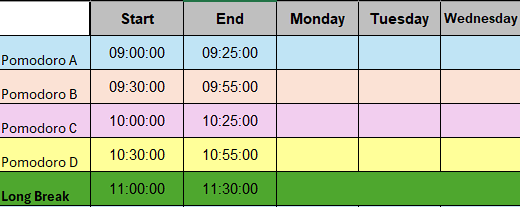
This is an automated spreadsheet built around the Pomodoro technique. There are two tabs for timetables.
- Weekly Timetable (term time)
- Weekly Timetable (holidays)
The difference being, one of them saves you writing “school” from 09:00 until 16:30.
On each tab there are two settings for you to change that will automatically change the start and end time of your revision sessions.
- Start time – The time you want to start your revision this week.
- Interval Period – The revision interval, the default is 25 minutes, but this can be changed from 25 up to 50.
Once you have configured your timetable, you need to start filling it in! You can choose to complete this electronically each week, or print it out.
Filling it in
Filling it in may sound easy, but it’s worthwhile spending some time thinking about what you want to cover each week or month.
Research has shown that small revision sessions as used in the Pomodoro technique combined with spaced retrieval (e.g. leaving time between revision) is an incredibly effective way to learn/revise. Some research has stated that this could have a 1-2 grade difference.
An example could be on Monday you start to Read and Recap* on the topic of the CPU. This could take just one pomodoro session on Monday. Tuesday you revisit your notes and turn them into a mind map, allowing you to see the connections between different pieces of information. Additionally, as the context (style) of the knowledge is different it will help to reinforce the learning. Wednesday you make flash cards. Thursday your test yourself with them, using them to find areas to work on. Then Friday you can quiz yourself, or revisit gaps identified by the flashcards, and then effectively repeat for another topic.
This example would help you build up a plethora of flashcards and revision notes that you can utilise when you revisit the topic later in your revision cycle. The Flashcards especially will help you identify areas where you may need to revisit with a larger revision sessions. See the flashcards section on how to use them effectively.
The approach above is not the absolute must, however the idea of leaving time , even a day, between revisiting a topic is, from a cognitive science point of view, very rewarding. So regardless of what technique you use, leaving time between the topic will help you learn as your brain has to work a little harder to retrieve the knowledge, making it more likely that it will stick into long term memory.
*detailed under the revision technique section.
An Example
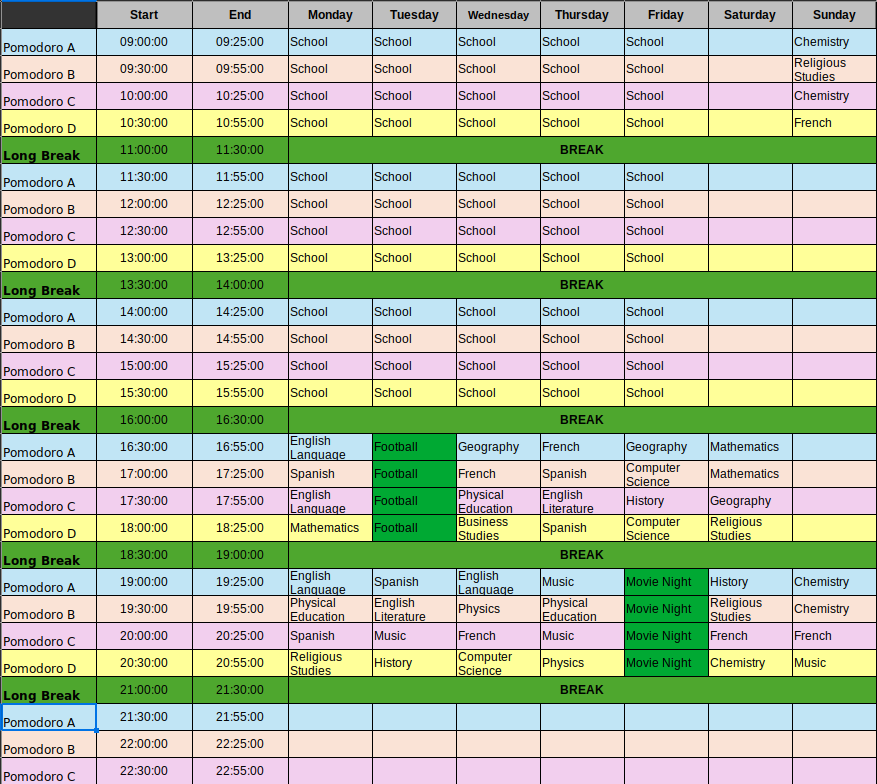
The below is an example of a possible time table for a Year 11 student. This takes into consideration some after school activities, but you would have to realistically plan those into your schedule.
In Year 10 you should be planning about 30-45 mins of revision for consolidation purposes during a weekday.
In Year 11 you should be planning 1-2 hours a day of revision, stepping this up on the weekends or holidays to 3-4 hours.
For Study Leave I’d aim for a parity of a school day with regards to how long you study for.
Things to remember:
- This is just an example
- Tailor it to your life, but still try and hit the 1-2 hour magic numbers. An unplanned night off once in a while won’t have a negative impact on your revision, and may be the break you need to find the motivation to revise the next night. Just don’t make a habit of the unplanned night off, all success requires self discipline.
- YOU ARE NOT A ROBOT
- This is especially important to remember over the holidays and weekends; leave time to be a person.
- Meet friends, relax, play games, exercise, sleep, binge Love Island or rewatch Game of Thrones. Whatever you enjoy, do it. It’ll help with motivation in the long run, and if you are consistent with your revision then you will feel like you’ve earned this time (and you have!). So enjoy it.
- EAT.DRINK.SLEEP
- A healthy balanced diet will help with energy levels, and water intake is important for focus. Notice I said water, and not energy drinks.
- Sleep is one of the most important elements that people often sacrifice. Don’t. Magic happens when you sleep and it’s so important for your cognitive health. Don’t revise until 10pm on a Tuesday and then play 2 hours of Fifa as a treat, because this will impact tomorrow. You’ll feel more tired, less focused, revision will be harder, motivation lower, and soon, Fifa starts at 8, because you’re too tired to revise.
Now you have the tools to start your revision journey, so let’s get started.
Leave a Reply